The Home of the Heron
George Inness · 1893
Explore the painting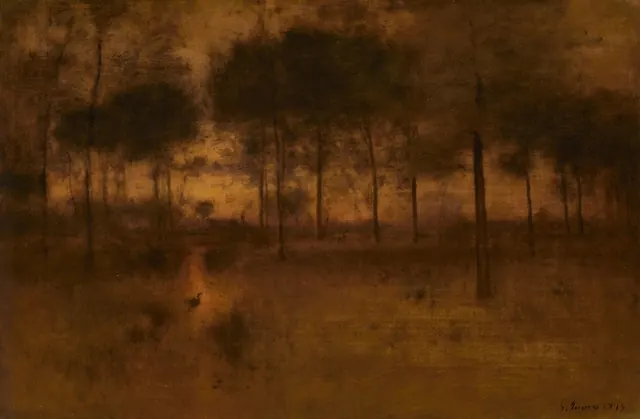
A small heron nearly disappears into dark water. The title promises a bird’s habitat, yet George Inness leaves its details barely distinct. Painted in 1893, shortly before his death, the work relates to the landscape of Tarpon Springs, Florida. In his later years he increasingly organised paintings around an overall condition of light, allowing individual objects to dissolve within it.
The heron stands left of centre, near a bright reflection. Its tiny dark silhouette provides a measure of the surrounding space. Almost motionless, the bird turns an indefinite field of colour into an inhabited place. A few decisive brush movements amid soft patches are enough for recognition.
Thin trunks on the far bank emerge from a shared brown tone. Inness drew on long experience of observing nature, but generally made larger paintings in the studio. Small studies preserved impressions. In the finished canvas he could combine and simplify them, adjusting light and detail to the whole.
Above, tree crowns merge into a dark mass. Inness knew European landscape painting, including the Barbizon artists, who favoured woods and rural places over heroic historical views. Here the forest occupies the space above us as a nearby environment in which the eye gradually learns to distinguish more shades.
Orange light passes between the trees and recurs in the water. Inness shared the thinker Emanuel Swedenborg’s ideas about connections between the natural and spiritual worlds. In this outlook, harmony in landscape could testify to divine presence. Transitions between trees, air and reflection make that connection available to the senses.
Broad, muted passages form the foreground water. Bank and reflection become almost inseparable in places. This can be experienced as a spiritual image of natural unity or as an account of vision in fading light. Both readings arise from the painting’s construction without requiring the heron to become a separate symbol.
Inness spoke of conveying his own impression of nature. Here he works towards that aim by limiting clarity. A bird, several trunks and reflected light provide enough bearings to sustain attention. The image of a place also becomes a study of how the eye gathers a coherent world from barely distinguishable forms.
- Medium
- Oil on canvas
- Collection
- Art Institute of Chicago
- Dimensions
- 76.2 × 115.2 cm
- Accession number
- 1911.31
Sources
Image provided under CC0. Image licence
Adapted and translated from Art Institute of Chicago materials. · Text licence