Madame Cezanne in a Yellow Chair
Paul Cezanne · 1888–90
Explore the painting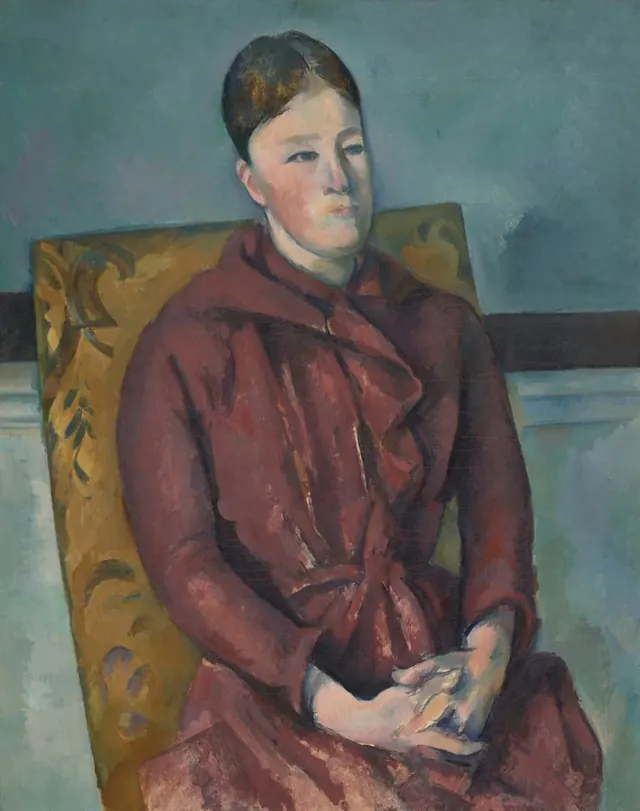
Hortense Fiquet posed for Cezanne for more than twenty years and became his most frequently painted model. This portrait belongs to four works with related clothing and pose. Examination suggests that the Chicago version’s outline was transferred from the first portrait. What resembles one prolonged sitting also involves repeating and reworking an existing image.
Pink, green and bluish areas construct her face. Its expression is restrained. Critics often converted such painted stillness into judgements about Hortense’s character. The Metropolitan Museum’s 2014 exhibition redirected attention to her sustained participation in the painter’s work.
Folded hands appear much more active than the face. Blue lines cross fingers and remain visible between patches of colour. They preserve the search for form. Calm face and agitated hand drawing differ primarily within the painting’s construction.
Yellow upholstery surrounds the figure, supporting the dark-red dress through colour and ornament. An object becomes as important to portraiture as a pose. Cezanne explores how neighbouring surfaces reinforce one another and hold a person in space.
Large folds carry the dress through the centre. Clothing supplies few small markers of fashionable status. Hortense appears as a continuing participant whose figure could be studied in successive versions. Repetition enables comparison without changing the principal model.
Dark and light passages alternate at the waist. Their angles connect with hands and chair. Colour relationships create volume. The portrait becomes both a person’s image and an investigation of stable form.
A dark horizontal strip crosses the blue wall. This apparently simple setting relates the chair’s inclination to the head’s position. Detailed domestic storytelling disappears. Attention rests on a few relationships that could change between versions.
Hortense and Paul met in 1869, their son was born in 1872, and they married in 1886. Cezanne long concealed his family from his father, complicating their lives and finances. Against that history, the portraits record sustained collaboration. A woman’s participation helped make possible experiments usually credited to one painter alone.
- Medium
- Oil on canvas
- Collection
- Art Institute of Chicago
- Dimensions
- 80.9 × 64.9 cm
- Accession number
- 1948.54
Sources
Image provided under CC0. Image licence
Adapted and translated from Art Institute of Chicago materials. · Text licence