Maharana Bhim Singh in Procession
Attributed to Ghasi · c. 1820
Explore the painting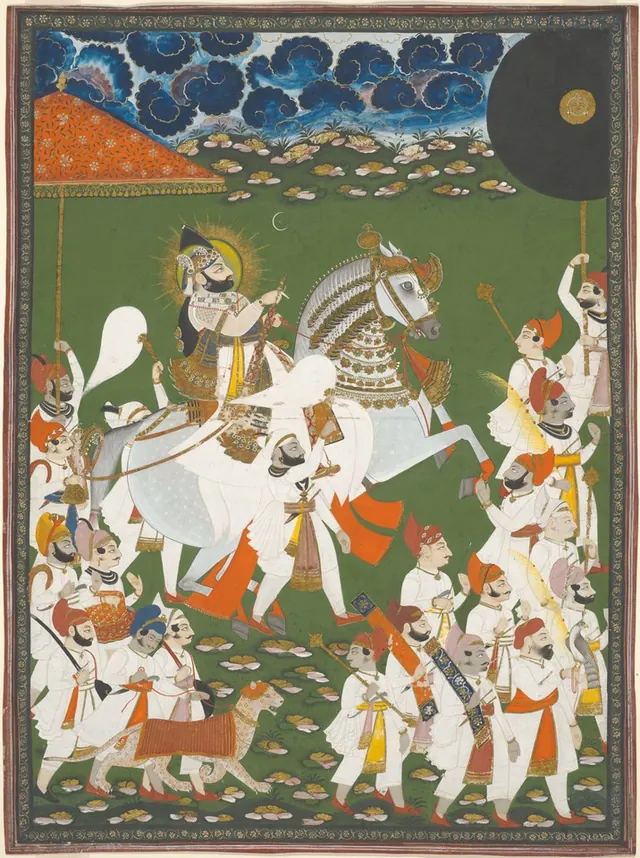
Maharana Bhim Singh rides through Mewar surrounded by a large entourage. His horse is richly adorned, a hookah mouthpiece rests in his hand, and emblems of authority rise above the procession. Attributed to Ghasi, the painting dates to about 1820. Only two years earlier Bhim Singh had accepted British protection by treaty. The display of magnificence must be considered alongside that loss of independence.
The white horse fills much of the centre. Raised legs establish movement, while its equipment matches the rider's richly ornamented dress. Smaller attendants make the ruler especially prominent. Scale and placement communicate rank, allowing even a viewer unfamiliar with Mewar's court to locate the principal figure immediately.
Bhim Singh wears an elaborate headdress and numerous jewels. His profile and moustache remain clearly visible. The mouthpiece shows that familiar comforts accompany a ceremonial outing. The museum connects this combination of display and leisure with an image of authority that projects pleasure as well as power.
A long flexible tube runs from the ruler's hand towards his attendants. Even this personal accessory involves the entourage. Such a detail reveals the court as an organised household supporting the sovereign's position. His public appearance depends on the people who maintain its required form.
A white flywhisk rises on the left. Attendants on both sides carry equipment and emblems of high status. Their figures are more closely packed and smaller than the rider. Their gestures connect the ground on which they walk with the elevated space occupied by the sovereign.
At the upper right a black disk contains a golden sun. This is a dynastic emblem of Mewar's Sisodia clan, recalling the ancestry and duration of its rule. Mewar had resisted the Mughal emperors; by the time this painting was made, new relations with the British shaped its political circumstances.
A cheetah is led on a leash, and a falcon also accompanies the party. Animals join weapons, jewels and ceremonial accessories within the courtly world. They broaden our understanding of the ruler's entourage. There is no need to infer a particular hunt, since the image primarily presents a royal procession.
Dense blue clouds rise above a flat green ground. Flowers and bright fabrics repeat small accents of red, white and gold. The conventional space accommodates the full ceremony and keeps its emblems visible. They are not subordinated to an accidental viewpoint that might hide attendants behind the horse.
The museum emphasises Bhim Singh's weak political position despite the imposing display. The painting records how the court continued to present its authority. Knowledge of the 1818 treaty makes the difference between the ruler's actual power and the dynastic dignity preserved by the procession particularly revealing.
- Medium
- Opaque watercolor and gold on paper
- Collection
- Art Institute of Chicago
- Dimensions
- Image, 57.1 × 41.6 cm
- Accession number
- 1975.507
Sources
Image provided under CC0. Image licence
Adapted and translated from Art Institute of Chicago materials. · Text licence