The Five Virtues
Ren Yi · Qing dynasty (1644–1911), 1895
Explore the painting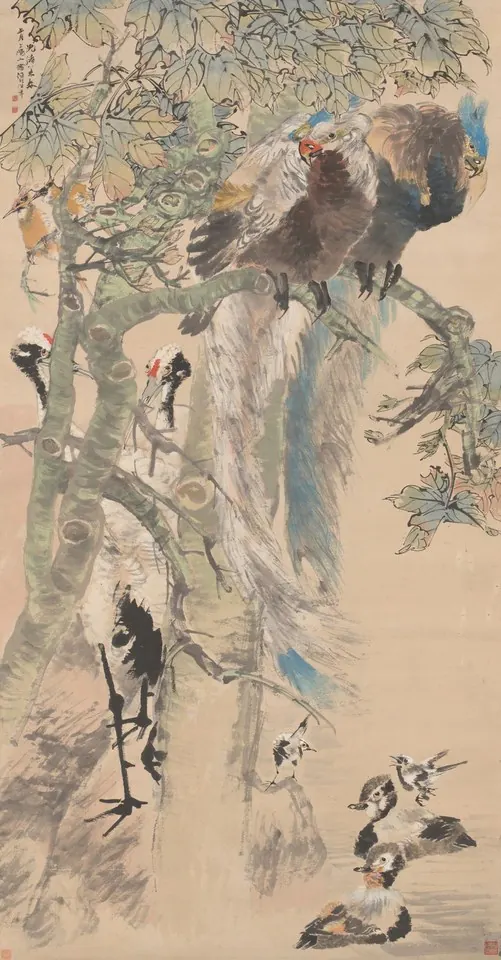
Ren Yi painted these birds in 1895, the final year of his life. Five pairs represent the fundamental relationships of Confucian society. One of Shanghai’s best-known painters, he worked for the city’s art market. Bird-and-flower painting could offer buyers both an attractive object and a familiar account of how life should be ordered.
Two long-tailed phoenixes sit at the top. Their highest and most prominent position corresponds to the relationship between ruler and subjects. Social hierarchy acquires a spatial form. The large mythical birds dominate the composition as the first relationship heads this system.
A small pair of orioles nestles among the branches on the left. They stand for relationships between older and younger siblings. Their scale differs from that of the phoenixes, but each pair is needed to complete the scheme. Family and state belong to a shared conception of order.
The phoenixes’ long tails descend through much of the scroll. Coloured washes turn into dry, barely perceptible brush traces. Ren Yi studied earlier Chinese painting and also encountered European approaches to modelling in Shanghai. His mature manner moved flexibly between precise outlines and freely applied patches.
Cranes emerge from behind the trunk. In this particular programme they represent children’s respect for parents. Cranes also commonly signified longevity, so the set of relationships guides the reading of an already familiar image. Meaning arises from the composition as a whole, with its complementary birds.
Lower down, two small wagtails interact above the water. They correspond to friendship. Their turns and open wings look particularly animated beside the large birds’ stillness above. Reciprocal movement makes their exchange visible before the viewer learns the symbolic scheme.
The ducks at the bottom represent marital fidelity. Water is only lightly indicated, keeping attention on the birds. The scroll combines unequal relationships, family duty and reciprocity under the idea of harmony. Its agreement therefore presupposes a particular social model.
Old values appear in a manner suited to a large commercial city’s lively art scene. A modern buyer could seek new forms for familiar convictions. The painting raises the question of whom its hierarchy promises to protect and what duties it assigns to each participant.
- Medium
- Hanging scroll; ink and colors on paper
- Collection
- Art Institute of Chicago
- Dimensions
- 185.9 × 97.2 cm
- Accession number
- 1943.133
Sources
Image provided under CC0. Image licence
Adapted and translated from Art Institute of Chicago materials. · Text licence