Dancer with a Maple Branch
Katsukawa Shunsho · About 1780-90
Explore the painting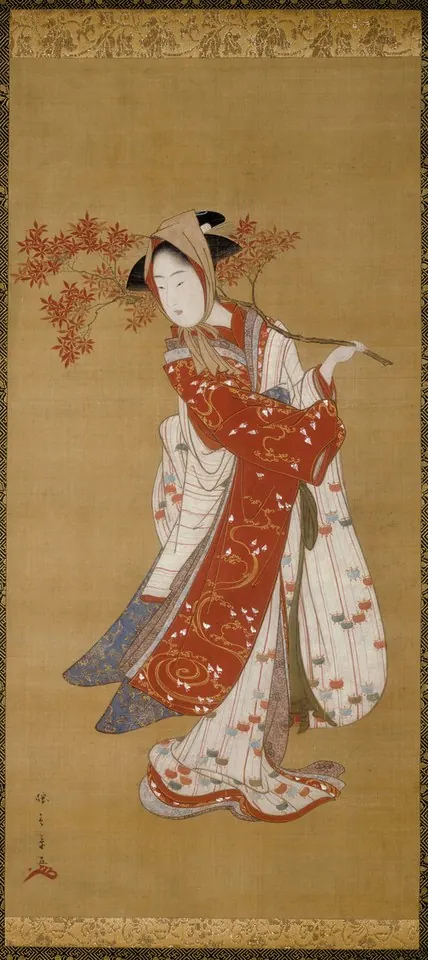
A dancer holds a maple branch and turns within long sleeves. She performs Momijigari, a dance associated with viewing autumn leaves. Katsukawa Shunshō painted her in the late eighteenth century, amid Edo’s active theatrical culture. For a familiar audience, branch and costume could evoke a performance without a stage, musicians or spectators.
Her lowered head appears almost in profile. Shunshō became known for images of actors and beautiful women, working in prints as well as painted scrolls. Here a single figure commands attention. Her clear facial contour remains distinct amid elaborate clothing.
Red leaves appear beside her head. Maple was an established autumn motif in Japanese poetry and imagery. Here the branch is also a performer’s prop. A natural season becomes part of choreographed movement, recognisable through shared cultural knowledge.
A hand holds the branch across her shoulders. Its position connects the body’s movement to a plant’s silhouette. A few directions convey dancing on a still scroll. The eye follows the branch, returning through the head’s inclination and the sleeves’ lines.
Red inner clothing appears beneath a partly loosened outer robe. Changing layers create a pattern of movement. The costume covers the body while revealing its turn through folds. The performer’s skill becomes visible in her command of substantial fabric.
The pale outer robe opens into a broad surface. Its small patterns reward close inspection. Public performance takes another form as a carefully executed painting available for domestic viewing. Pleasure now depends on lines and colours that survive after the actual movement ends.
The hem gathers around her feet, continuing the figure’s curve. An empty background removes the silhouette from everyday circumstances. We encounter an image of skill and beauty while the preparation of a performance remains unseen. Idealisation highlights her art and leaves her biography outside the picture.
Shunshō retained a single figure and a branch from the performance. A viewer familiar with Momijigari could recall the dance; others would first notice the turning body, long sleeves and red leaves. The same painting accommodates different degrees of theatrical knowledge. It permits long, close viewing of a movement that lasted only a moment.
- Medium
- Hanging scroll; Ink, color, and gold on paper
- Collection
- Art Institute of Chicago
- Dimensions
- 58.7 × 28.1 cm
- Accession number
- 1939.1946
Sources
Image provided under CC0. Image licence
Adapted and translated from Art Institute of Chicago materials. · Text licence