A Monumental Portrait of a Monkey
Attributed to Stipple Master · c. 1705–1710
Explore the painting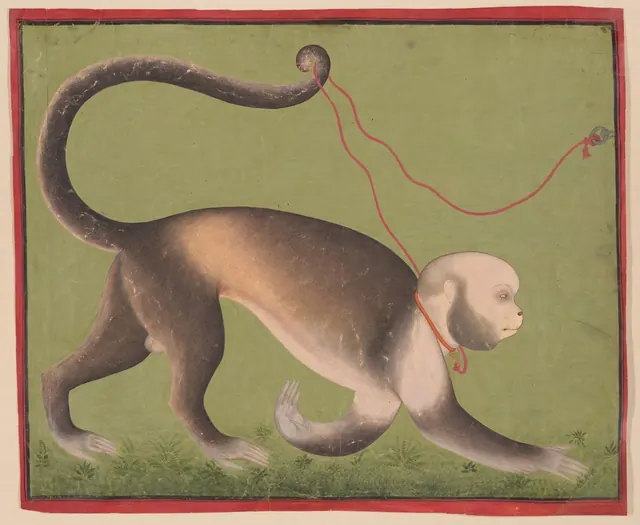
This monkey's name has survived: Husaini. An inscription on the reverse connects the animal with Nawab Davad, or Daud, Khan. The museum proposes Daud Khan Panni, a military commander and administrator in the Mughal Empire. The record singles out an individual animal. Independent monkey portraits are uncommon in Indian painting; images of the revered monkey-form hero Hanuman belong to a different category.
Pale eyes, a projecting nose and dark hair around the cheeks make the face distinctive. Tiny brush touches describe transitions between nearly bare skin and fur. The painter's name is unknown. Scholars call the artist the Stipple Master after this characteristic modelling through countless small marks.
The long tail occupies almost the entire upper half of the sheet. It curves above the back and ends in a tight curl. An empty green ground makes the whole outline legible. No palace or company of courtiers explains the animal through its surroundings. Its body becomes the principal subject of close observation.
A red cord runs from the collar through the tail’s curl to a ring on the right. The fine line connects the body with the sheet’s edge. The animal has a name and an individual portrait, while a tether restricts its movement. Close study of appearance meets another subject: a creature’s position at a court that kept it under human control.
One forelimb reaches far forward, its fingers touching the ground, while the other arm is bent. The pose makes bodily movement visible, and the red tether shows its limit. Even against an almost empty ground, the portrait preserves the relationship between the animal and the person keeping it nearby.
The other hand turns its palm towards us. Long fingers accentuate a resemblance to a human hand. Together with the bearded face and pale eyes, this detail strengthens a sense of individual character. The painter applies court portraiture to an unusual model, carefully distinguishing skin, fur and the structure of limbs.
The rear feet stand among small plants. Pale skin echoes the face and forehands, connecting different parts of the body. The work belongs to the courtly circle of Amar Singh II of Mewar, who ruled from 1698 to 1710. The museum associates about forty-six works with this ruler and the anonymous artist, although the attribution remains a scholarly reconstruction.
The portrait can be read as exceptional attention to an individual animal and as evidence of courtly possession. Husaini's name survived through a human record of association, while the painter's name was lost. That uneven distribution of memory matters. Close observation preserves the model's individuality, while inscription and tether place it within human relationships and power.
- Medium
- Opaque watercolor and gold on paper
- Collection
- Art Institute of Chicago
- Dimensions
- Image, 45 × 56 cm
- Accession number
- 2011.248
Sources
Image provided under CC0. Image licence
Adapted and translated from Art Institute of Chicago materials. · Text licence