The Captive Slave (Ira Aldridge)
John Philip Simpson · 1827
Explore the painting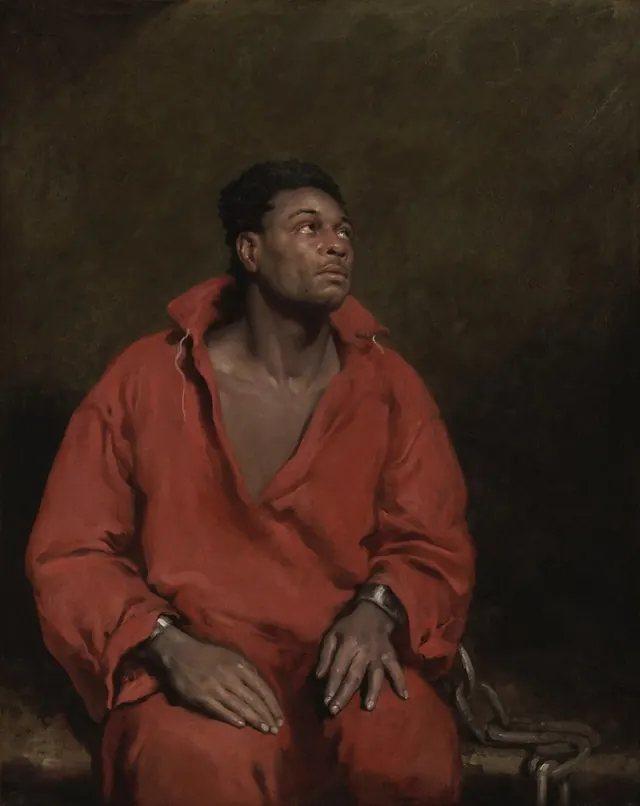
The man in this painting is chained, but its model Ira Aldridge was born free. An American actor celebrated in Europe for playing Othello, he also spoke against slavery. John Philip Simpson painted him in 1827, during the British campaign to abolish slavery in the colonies. The image participated in a political appeal to its audience.
The face turns upwards towards light, recalling European representations of Christian martyrs. The museum connects this choice with an appeal to wealthy white viewers who could influence policy. A familiar sacred pose made an enslaved person's suffering legible to their sympathy. That process of mediation itself deserves attention.
The open red shirt sets the neck and chest against a dark background. Clothing fills much of the picture without distracting from the face. Colour and illumination sustain an individual's presence where the title names a social condition. Knowing the actor's identity also allows us to recognise professional work in constructing the expressive pose.
The sitter’s right hand rests on his thigh, its fingers extended in a restrained pose. European religious painting associated such composure with martyrdom. Aldridge’s expressive presence asks viewers to linger before a person in chains. Behind the role stands his own public activity against slavery.
An iron cuff encircles the other wrist, introducing the part the actor performs within the painting. The museum suggests his appearance in Thomas Morton's musical drama The Slave as a possible immediate stimulus. That connection remains tentative; the model's identity is more securely established.
A chain descends towards the edge of the bench. Large links continue beyond the lower boundary, extending restriction outside the visible scene. Unlike the indefinite background, the object is clear. Slavery is represented by specific coercion rather than an unspecified atmosphere of sadness.
The simple bench supplies little context. Simpson does not identify a plantation, ship or prison. That reduction makes the image suitable for a general abolitionist appeal. It also removes the represented captive's particular social history, centring suffering before the public's gaze.
At the Royal Academy exhibition of 1827, lines from William Cowper's antislavery poetry accompanied the picture. British colonial emancipation legislation followed in 1833. The work can be read as an appeal for sympathy and as a Black actor's participation in a struggle for rights. The latter perspective keeps Aldridge from becoming an anonymous body used by a white painter to construct a persuasive image.
- Medium
- Oil on canvas
- Collection
- Art Institute of Chicago
- Dimensions
- 127 × 101.5 cm
- Accession number
- 2008.188
Sources
Image provided under CC0. Image licence
Adapted and translated from Art Institute of Chicago materials. · Text licence