Beata Beatrix
Dante Gabriel Rossetti · 1871–72
Explore the painting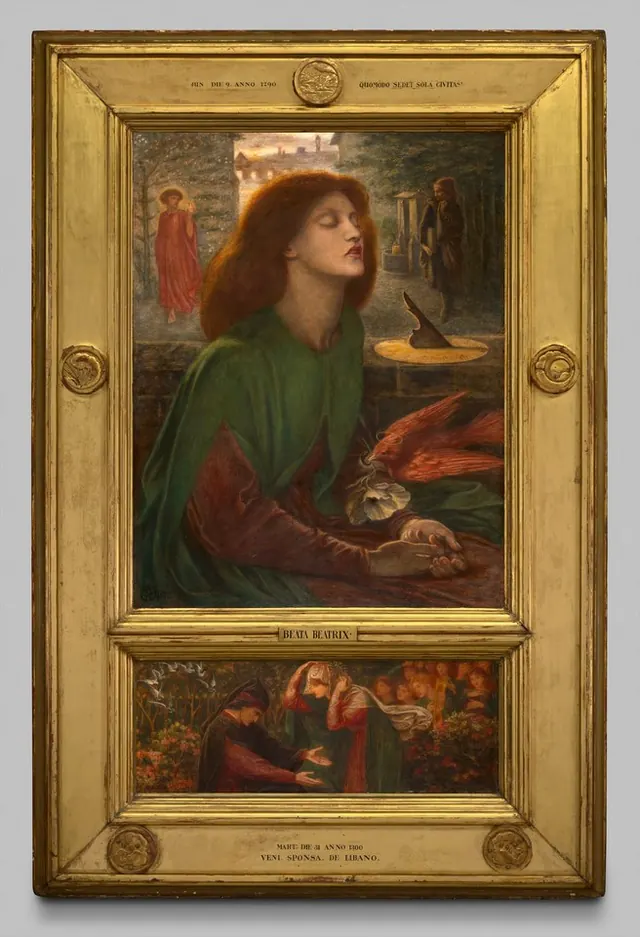
Dante Gabriel Rossetti joined medieval poetry with remembrance of his wife Elizabeth Siddal in Beata Beatrix. Dante's New Life, devoted to Beatrice, supplied its literary foundation. The Chicago painting was made in 1871–72 as a second version for collector William Graham. Rossetti added a lower scene that materially changes the narrative's conclusion.
Closed eyes and an uplifted face separate the woman from her surroundings. Rossetti described a spiritual, trance-like state and cautioned against reading it as a literal death scene.
A red dove with a halo brings a white poppy. Rossetti called his wife Dove; the poppy connects with opium and her death from a laudanum overdose. A survivor made the painting, combining bereavement with a religious and poetic story.
Her hands rest loosely, palms partly open beside the flower. Their stillness sustains the inward state described by the artist. Deep green and red clothing retains the figure's bodily weight as the background recedes. Pose, colour and objects familiar to Dante's readers make an inner experience visible.
A sundial introduces time and the number nine, significant in Dante's account. Love personified stands at the left rear, Dante on the right; Florence's Ponte Vecchio appears in the distance. These surroundings turn portrait resemblance into literature. Medieval Florence and the nineteenth-century artist's personal memory coexist.
In the lower panel Dante encounters Beatrice again in paradise. This predella continues the main image, offering reunion after separation. Rossetti added it to the second version. Repeating the painting for another owner thus produced a new narrative in which an encounter completes the theme of loss.
Rossetti also designed the frame. Inscriptions connect the image with dates in Dante's narrative and the biblical lament for a deserted city that Dante applied to mourning Florence. Broad gilding makes the work an organised memorial object. The frame contributes to reading as much as the painting, although reproductions often crop it away.
Here a woman's memory passes through two male authors' stories, Dante's and Rossetti's. Recognising that mediation does not diminish grief, but establishes its limits. We learn what image the painter preserved; Siddal's complete life exceeded it. The reunion in paradise offers access to the artist's hope without documenting the absent woman's feelings or wishes.
- Medium
- Oil on canvas
- Collection
- Art Institute of Chicago
- Dimensions
- 87.5 × 69.3 cm
- Accession number
- 1925.722
Sources
Image provided under CC0. Image licence
Adapted and translated from Art Institute of Chicago materials. · Text licence