Alessandro de' Medici
Pontormo, · 1534–35
Explore the painting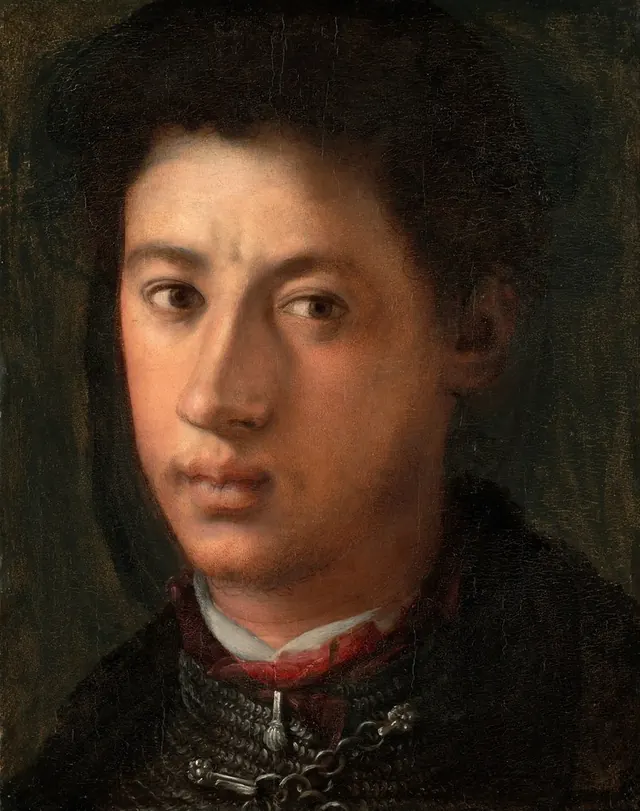
When Pontormo painted Alessandro de’ Medici around 1534–1535, Florence had recently become a duchy. Following the siege of 1529–1530, the republic lost its independence; in 1532 Alessandro received the hereditary ducal title. This small portrait prepared for a larger image of the ruler. It shows how an individual face could become a recognisable public image.
The head fills almost the whole surface. The eyes look aside while light picks out the forehead, nose, lips and chin. Pontormo preserves differences between the two sides of the face. The future formal image thus has an individual basis that the workshop could use in further work.
The dark headwear almost merges with the background. Its broad silhouette surrounds the illuminated face, leaving few distractions. At the Florentine court, portraits could present the new ruler to people who had never met him. A preparatory likeness established his features for that wider representation.
Red fabric appears as a narrow strip around the neck. The restrained clothing recalls how ducal government did not immediately erase the habits of a city with a republican past. The transition from civic self-presentation to dynastic imagery became a major theme of sixteenth-century Florentine portraiture.
Separate touches of light describe a silvery fastening. It makes the clothing valuable without displacing the face. The political history of this modestly sized object belongs to a larger production of images communicating continuity, rank and legitimate authority.
Curls and the soft transition of light at the temple become especially apparent up close. Historian Catherine Fletcher considers the combined visual and written evidence a strong basis for identifying Alessandro’s mother as African. The precise circumstances of his birth remain debated. Fletcher also notes a change in the question itself. Contemporaries were particularly concerned with his mother’s low social standing; modern museums additionally debate the visibility of Africans in European history.
In 1537 his relative Lorenzino murdered Alessandro. Power passed to another Medici branch, represented by the young Cosimo. The preparatory portrait outlived its sitter’s rule and acquired a different function. Its close study of a face can now be set against the brevity of personal power during the formation of a lasting dynastic system.
- Medium
- Oil on panel
- Collection
- Art Institute of Chicago
- Dimensions
- 35.3 × 25.8 cm
- Accession number
- 1933.1002
Sources
Image provided under CC0. Image licence
Adapted and translated from Art Institute of Chicago materials. · Text licence